AVAILABLE NOW
To My Beloved Norwegian Countrymen — Nils Trulsen Bru and the Making of Modern Norway
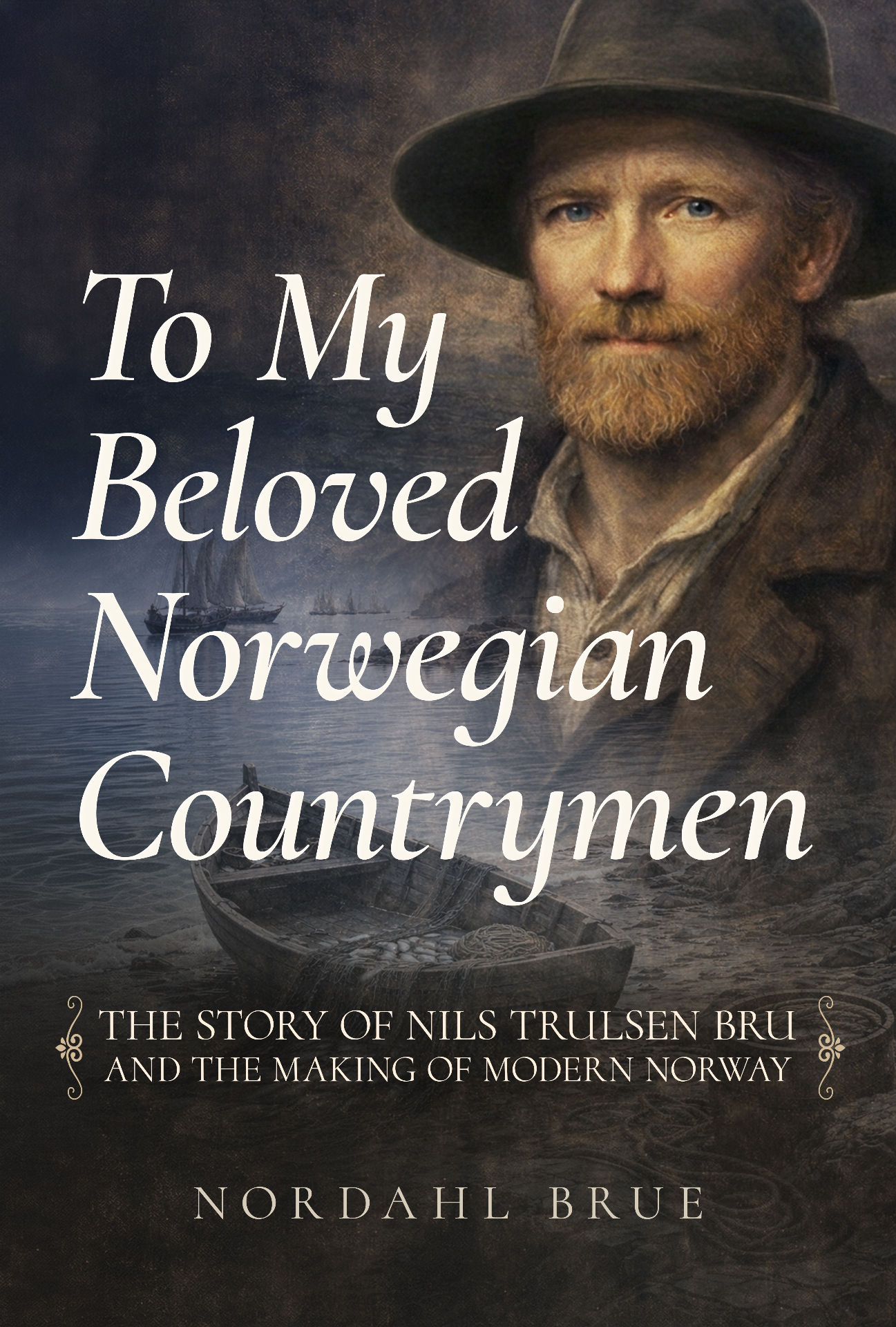
Now available: order To My Beloved Norwegian Countrymen on Amazon.
Overview
A farmer/fisherman defends himself against the bureaucracy while fighting for freedom of speech, religion, and trade. He earns the support of his fellow fishermen as well as the followers of Hans Nielsen Hauge and is exonerated after two trials. The causes he championed were central to the making of modern Norway.
In this deeply researched genealogical biography, Nordahl Brue traces the life of his ancestor Nils Trulsen Bru (1776–1823), guided by five defining forces — family, farm, faith, fishing, and freedom of speech. Bru championed religious reform, opposed unjust church tithes, and fought for farmers to have a voice in Norway's newly formed parliament. When authorities sought to silence him, he turned to Norway's new Constitution to defend his rights.
Drawing on archival records and newly uncovered historical sources, this vivid microhistory brings to life the turbulent years surrounding Norway's 1814 Constitution and the rise of democratic participation among farmers and fishermen.
Praise for To My Beloved Norwegian Countrymen
Understanding one's history is essential to understanding who we are. This book offers valuable insight into the shaping of Norwegian democracy and the role of farmer-fishermen in 1814 — one of the most significant turning points in Norwegian history. That year marked Norway's transition from centuries of foreign rule toward modern statehood and democratic self-government. The book will be of particular interest to Norwegian Americans seeking to explore their roots, heritage, and the experiences that shaped earlier generations.
Not just a good yarn, it taught me a new dimension of The Enlightenment and Napoleonic Wars.
Beautiful…weaves everything together, from what crops were grown to the changing institutions.
Very interesting and well researched. Women are often overlooked in history… it is great that you give Kristi credit and space in your narrative.
Once I started reading, I could hardly put it down. There was a lot in it that was new to me. I found the detailed reviews and discussions of the legal documents very interesting—Nordahl Brue's expertise as a lawyer gives the material extra weight.
To My Beloved Norwegian Countrymen draws upon many sources that family historians often overlook—or maybe don't even realize exist. This book will inspire genealogists to dig a little deeper as they explore their own family's stories.
Genealogy, done well and explained fully, introduces us to persons who actually lived. This cannot help but enrich us by introducing and explaining our ancestors and enrich our overall cultural understanding. Readers will enjoy learning about N. T. Brue and how his "history with a small h" had an impact on "History with a capital H."
To My Beloved Norwegian Countrymen is a valuable contribution to understanding the changes Norway experienced in the first two or three decades of the 19th century. It is an engaging read that leaves one eager to see what's in the next chapter. I look forward to making it a frequent reference in my modest library. Bravo!
As To My Beloved Norwegian Countrymen notes, stories from the past still matter. Nils Trulsen Bru's courage is the force that allowed other virtues like faith, leadership, resilience, fortitude, modesty (Janteloven!) to shine through at key moments in his life—an important thing to take note of in any era!
An engaging read and with a tone of openness and curiosity that was inviting.
I found your descriptions of life in this small capsule of Norwegian history both interesting and informative. I especially appreciate the effort to flesh out what a life was like, not just who the person was in the long chain of descent… That you accomplished this not just for NTB but for the women in his world and their role in his success (and vice versa) expands the narrative from the individual to the family system.
Excerpt — Preface: Independence as a Football Game
Imagine this: one year your country is little more than a sidekick in someone else's empire — by the end of that same year, it's writing its own rules and telling kings how things are going to work. That was Norway in 1814. In just ten whirlwind months, it went from junior partner to the Danish crown to a nation drafting its own constitution and negotiating a new arrangement with the Swedish king. Full independence would not come for nearly a century, but the spark was lit in that one wild, game-changing year.
To borrow an American football analogy, think of Norway as a small Division III football team suddenly thrown into a matchup with a national powerhouse. It's 1814, and no one expects the underdogs to last a quarter. But Norway takes the ball deep in their own end zone and starts moving: bold passes, clever plays, hard-fought runs. They make mistakes, recover fumbles, and push forward through a blizzard of penalties — some against them, some against their much stronger opponent. By year's end, they've reached the five-yard line of self-rule. And then, for the next ninety-five years, they inch their way toward the end zone of full independence.
NTB (Nils Trulsen of Bru, 1776–1823), my great-great-great-grandfather, wasn't the quarterback, but he was on the field. Think of him as an offensive lineman, blocking defenders, clearing the way, protecting the playmakers. But once Norway closed in on the goal line, Nils did something unexpected: he began calling for more players — farmers, fishermen, and everyday people — to join the game.
Today, NTB is remembered as a leader of the farmer-fisherman movement, a force that shaped the early direction of a new Norway. He helped place a few of the stones on which modern Norway rests — and the impact of his work still matters today.
Publication Details
- Format
- Hardcover, ebook
- Availability
- Available now